
You exercise regularly, eat healthy foods, and may have even lost weight in other areas of your body. But that stubborn little pouch in your lower abdomen? It simply refuses to go away. You’re not imagining things — and it’s definitely not a lack of willpower or discipline.
The lower belly pooch is fundamentally different from fat in other areas of your body, and there are fascinating scientific reasons why it’s so persistent. This isn’t about blame or shame. It’s about understanding what’s really happening in your body so you can make informed decisions about your health and confidence. You’re not alone in this struggle, and understanding the true causes is your first step toward finding a real solution.
Let’s dive into what lower belly pooch actually is, why it happens, and most importantly — what you can realistically do about it.
What exactly is a lower belly pooch?
Lower belly pooch refers to a bulge or protrusion in the lower abdominal area, specifically below the belly button. Unlike general belly fat that can accumulate around your entire midsection, this concern is focused on that distinct lower region that often resists even your best efforts.
Here’s what makes it different: the lower belly pooch isn’t just one thing. It can be:
- Subcutaneous fat (soft, pinchable fat under the skin)
- Visceral fat (deeper fat around the organs)
- Loose or stretched skin
- Weakened or separated abdominal muscles
- Or — most commonly — a combination of these factors
This condition affects both men and women, though patterns differ. Women often notice it after pregnancy or during menopause, while men typically see it develop with age, stress, or hormonal changes.
Most adults over 30 experience some degree of lower abdominal fat accumulation, making this one of the most common body concerns.
👉 Key takeaway: your lower belly pooch likely has a specific cause — or combination of causes — and identifying it is crucial for choosing the right solution.
Different types of lower belly pooch
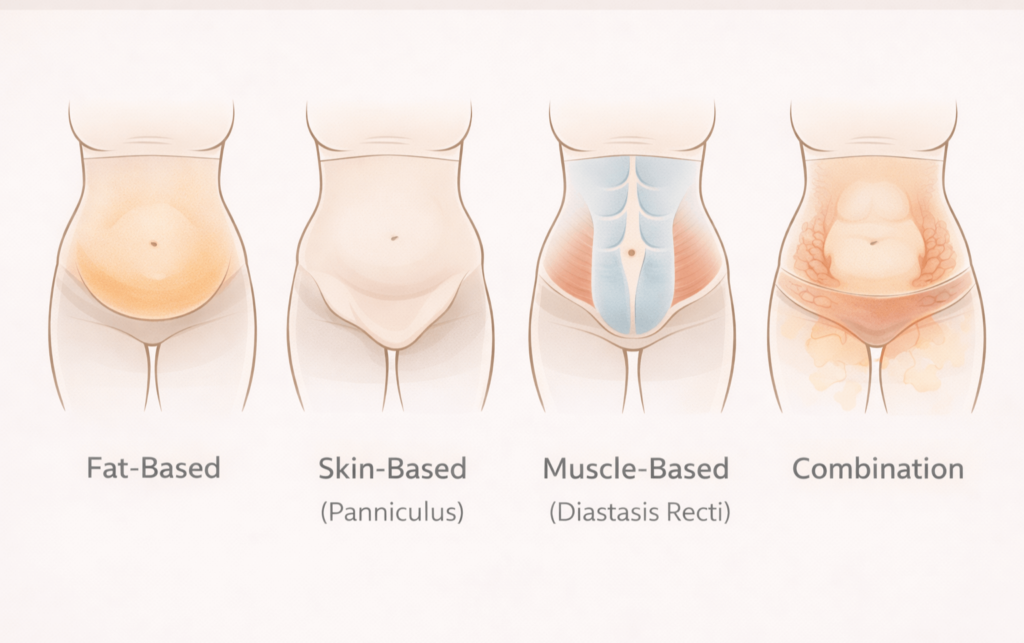
Not all lower belly pouches are created equal. What works for one person might not work for another because the underlying cause can be completely different.
1. Fat-Based Lower Belly Pooch
The most common type, involving actual fat accumulation — either:
- Subcutaneous fat (soft, squishy, pinchable)
- Visceral fat (firm, deeper, harder to pinch)
How to identify it:
👉 Pinch test
- Can pinch soft tissue → Subcutaneous fat
- Feels firm, hard to pinch → Visceral fat
Good news: This type can respond to diet and exercise, but the lower belly is usually the last place fat leaves.
2. Skin-Based Pooch (Panniculus)
A panniculus is primarily loose, stretched skin that hangs in the lower abdominal area. This type often contains some fat, but the main issue is the skin itself, which has lost its elasticity and doesn’t “snap back” to its original position.
It often appears:
- After significant weight loss
- After pregnancy
- After multiple pregnancies
Important reality check:
👉 Exercise cannot fix loose skin.
Once elasticity is lost, it won’t naturally tighten back up.
In severe cases, a panniculus can cause rashes, irritation, or infections, making it more than cosmetic.
3. Muscle-Based Pouch (Diastasis Recti)
Diastasis recti occurs when the rectus abdominis muscles (your “six-pack” muscles) separate along the center line of your abdomen. This creates a gap that allows your internal organs and tissue to push forward, creating a bulge or dome-shaped protrusion.
How to identify it:
Lie on your back → lift your head slightly → feel a gap of two or more finger-widths.
- Extremely common post-pregnancy (up to 60% of women)
- Can also affect men with improper core training or weight fluctuations
⚠️ Crunches and sit-ups can make it worse.
This type requires specific therapeutic exercises or surgery in severe cases.
4. Combination Pooch (Most Common)
Here’s the truth most people don’t realize: the vast majority of lower belly pouches involve a combination of these factors. You might have some stubborn fat, some stretched skin, and some muscle weakness all contributing to the problem.
For example, after pregnancy, many women have all three: excess fat from weight gain, stretched skin from the expanding belly, and diastasis recti from the abdominal muscles separating. Or someone who has lost significant weight might have loose skin plus remaining pockets of stubborn fat.
This is exactly why one-size-fits-all solutions often fail. Your best friend might lose her lower belly with consistent exercise, while you see minimal results — not because you’re doing something wrong, but because the underlying causes are different.
A professional evaluation can help you identify which factors are at play in your specific situation so you can pursue the most effective solution.
🔍 QUICK SELF-ASSESSMENT: What Type Do You Have?
- Pinch test: Can you pinch a lot of soft tissue? → Likely fat-based
- Jiggle test: Does loose skin jiggle significantly? → Likely skin-based (panniculus)
- Gap test: Feel a gap when doing a mini crunch? → Check for diastasis recti
- Combination: Notice multiple signs? → Most likely combination type
For accurate diagnosis and personalized treatment planning, consult with a board-certified professional.
The main causes of lower belly pooch
Now that you know what type of pooch you might have, let’s explore why it happens in the first place. Understanding the root causes can be empowering — it shifts the conversation from “What’s wrong with me?” to “What’s happening in my body, and what can I do about it?”
The causes of lower belly pooch are multifactorial, meaning multiple factors often work together to create the problem. We’ve organized them into three main categories: hormonal causes, structural and anatomical causes, and lifestyle factors. Some of these you can control, while others are simply part of being human.
Category 1: Hormonal Causes
Your hormones act as chemical messengers that control where and how your body stores fat. When your hormonal balance shifts — which happens naturally throughout life — your body may start storing more fat in your lower abdomen. This isn’t a personal failure; it’s biology.
Cortisol (The Stress Hormone)
Cortisol has earned its reputation as the “stress hormone,” and for good reason. When you’re under chronic stress — whether from work pressure, relationship issues, financial worries, or even overtraining at the gym — your body produces elevated levels of cortisol as part of its survival response.
Here’s the problem: high cortisol levels signal your body to store fat, particularly in the abdominal area.
Why? From an evolutionary perspective, cortisol was designed to help you survive threats by ensuring you had energy reserves. Your body doesn’t distinguish between the stress of running from a predator and the stress of a demanding boss — it responds the same way.
This creates a frustrating cycle: stress increases cortisol, cortisol promotes belly fat storage, belly fat causes more stress about your appearance, which increases cortisol even more. Poor sleep, which also elevates cortisol, compounds the issue.
Managing stress through meditation, adequate sleep, regular exercise, and relaxation techniques isn’t just good for your mental health — it’s essential for managing stubborn belly fat.
Estrogen Fluctuations (Women)
Estrogen plays a crucial role in where women store body fat. When estrogen levels are balanced, women typically store fat in their hips, thighs, and buttocks (the classic “pear” shape). But when estrogen fluctuates or declines, the distribution pattern changes dramatically.
This happens during several life stages. Your menstrual cycle causes temporary bloating and water retention in the lower abdomen that many women notice. But the more significant changes occur during perimenopause and menopause, when estrogen levels drop substantially. This hormonal shift causes fat to redistribute from the hips and thighs to the abdomen, particularly the lower belly.
Many women who maintained a relatively flat stomach their entire lives suddenly find themselves battling a lower belly pooch in their 40s and 50s, even without gaining overall weight. This isn’t your imagination, and it’s not laziness — it’s a natural hormonal transition. While you can’t stop menopause, understanding this connection helps you adjust your expectations and strategies.
Testosterone Decline (Men)
Men aren’t off the hook when it comes to hormonal belly fat. Testosterone levels naturally decline with age, typically starting in the 30s and accelerating after 40. Low testosterone is strongly linked to increased abdominal fat storage, particularly visceral fat (the deeper, more dangerous type).
The connection works both ways: low testosterone promotes belly fat, and belly fat actually lowers testosterone by converting it to estrogen through an enzyme called aromatase. This creates another frustrating cycle. Lifestyle factors like poor diet, lack of exercise, inadequate sleep, and chronic stress can accelerate testosterone decline beyond normal aging.
Men with lower belly pooch should consider having their testosterone levels checked, especially if accompanied by other symptoms like fatigue, decreased muscle mass, or low libido. While testosterone replacement isn’t right for everyone, addressing low levels through lifestyle changes or medical intervention can help with belly fat in addition to overall health.
Insulin Resistance
Insulin is the hormone that helps your cells absorb glucose (sugar) from your bloodstream. When you consistently consume high amounts of sugar and refined carbohydrates, your body produces more and more insulin to handle the blood sugar spikes. Over time, your cells can become resistant to insulin’s effects, requiring even more insulin to do the same job.
High insulin levels signal your body to store fat rather than burn it. And where does it preferentially store that fat? Your abdomen, particularly the lower belly. Insulin resistance also makes it much harder to lose weight because your body is essentially locked in “storage mode.”
The good news is that insulin resistance is often reversible. Reducing sugar and refined carbs, increasing fiber intake, regular exercise (especially strength training), and losing even 5-10% of your body weight can significantly improve insulin sensitivity.
This isn’t just about aesthetics — insulin resistance is a precursor to type 2 diabetes, so addressing it benefits your overall health substantially.
Category 2: Structural & Anatomical Causes
Sometimes the lower belly pooch isn’t primarily about fat at all. Structural issues — how your body is built, how it’s changed, or how it’s positioned — can create or contribute to the appearance of a lower belly bulge.
Pregnancy and Postpartum Changes
Pregnancy represents one of the most dramatic physical transformations a body can undergo, and it leaves lasting changes that many women aren’t fully prepared for. As your uterus expands to accommodate a growing baby, your abdominal muscles, skin, and connective tissue all stretch significantly.
The rectus abdominis muscles (your “six-pack” muscles) may separate along the center line, creating diastasis recti. The skin stretches to capacity, and the connective tissue network weakens. After delivery, even as the uterus shrinks back down, the abdominal wall often doesn’t fully return to its pre-pregnancy state.
This is completely normal and incredibly common — yet many women feel like they “failed” when their stomach doesn’t bounce back within weeks or months.
Let’s be clear: your body grew as a human being. The changes it underwent were necessary and natural. While some women’s bodies recover more completely than others due to genetics, age, number of pregnancies, and other factors, having a postpartum pooch isn’t a sign of weakness or poor effort.
A realistic timeline for natural recovery is 6-12 months postpartum, and even then, many women retain some degree of lower belly pooch. This may include loose skin that won’t retighten on its own, separated muscles that need targeted therapy or surgery to repair, and stubborn fat deposits.
If you’re several years postpartum and still bothered by your lower belly despite healthy habits, you’re not alone — and surgical options like a tummy tuck or mommy makeover exist specifically for this reason.
Read more:
👉 How do celebrities get a flat stomach after pregnancy?
Posture and Anterior Pelvic Tilt
Here’s something many people don’t realize: your lower belly can appear to protrude even without excess fat, simply due to how you’re holding your body. Anterior pelvic tilt — when your pelvis tilts forward — causes your lower back to arch excessively and pushes your abdomen forward, creating the appearance of a belly pooch.
Think of your pelvis as a bowl of water. If the bowl tips forward, the water (your internal organs and abdominal contents) spills forward, creating a bulge. This posture issue is incredibly common in modern society because we spend so much time sitting. Prolonged sitting tightens your hip flexors and weakens your core muscles, particularly the deep transverse abdominis and gluteal muscles that help maintain proper pelvic alignment.
The good news? If posture is contributing to your lower belly pooch, it’s correctable through targeted exercises that strengthen your core and glutes while stretching tight hip flexors. Physical therapy, Pilates, and specific corrective exercises can make a significant difference. However, it requires consistent effort and awareness to retrain your body’s default posture patterns.
Genetics and Body Type
Some aspects of your body composition are written in your DNA. Genetics influence where your body preferentially stores fat, your natural body shape, and how your body responds to diet and exercise. Some people are genetically predisposed to store more fat in their lower abdomen, regardless of their overall body weight.
Different ethnic backgrounds also show different patterns of fat distribution. For instance, some populations are more prone to central (abdominal) fat storage, while others tend toward peripheral (hip and thigh) storage.
Your individual genetic blueprint determines your body type — whether you’re naturally more of an “apple” shape (fat around the middle), “pear” shape (fat in hips and thighs), “hourglass,” or “rectangle.”
If your mother, grandmother, or other close relatives have a similar body shape and struggled with lower belly fat, there’s a good chance genetics are playing a role in your situation. This doesn’t mean you’re powerless — lifestyle factors still matter enormously — but it does help explain why you might have to work harder than someone else to achieve the same results.
Understanding your genetic predisposition helps you set realistic expectations. You can’t fight your fundamental body type, but you can optimize within it. Focus on what you can control: your diet, exercise, stress levels, and sleep. And remember that “stubborn” doesn’t mean “impossible.”
Category 3: Lifestyle & Environmental Causes
This is the category where you have the most control. While you can’t change your genetics or stop aging, you can absolutely modify these lifestyle factors — and doing so can make a substantial difference in managing lower belly fat.
Aging and Metabolism
As much as we’d like to deny it, aging brings predictable changes to body composition. Starting around age 30, you naturally begin losing muscle mass at a rate of about 3-5% per decade, a process called sarcopenia. Since muscle tissue burns more calories than fat tissue, losing muscle means your metabolism slows down.
At the same time, your skin loses elasticity due to decreased collagen and elastin production. Hormonal changes (which we covered earlier) redistribute fat toward your abdomen. And your basal metabolic rate — the calories you burn just existing — decreases by approximately 2-3% per decade after 30.
This means that even if you eat and exercise exactly the same way you did in your 20s, you’re likely to gain fat (particularly in your lower belly) as you age. Many people find this incredibly frustrating, interpreting it as personal failure when it’s actually normal biology.
The empowering news is that strength training can combat sarcopenia. Building and maintaining muscle mass helps keep your metabolism elevated, which makes it easier to manage body fat. While you can’t stop aging, you can significantly slow its effects on your body composition through consistent resistance exercise and adequate protein intake.
Diet and Nutrition Factors
The saying “abs are made in the kitchen” exists for a reason. What you eat has an enormous impact on belly fat accumulation.
Excess sugar and refined carbohydrates cause blood sugar spikes, insulin surges, and fat storage — particularly in the abdominal area. These foods also promote inflammation throughout your body, which is increasingly recognized as a driver of weight gain and difficulty losing fat.
Processed foods high in sodium cause water retention, which can make your lower belly appear more bloated and pronounced. Alcohol, especially beer and sweet cocktails, contributes empty calories and can disrupt your hormones, promoting belly fat storage. Even drinking too much diet soda, despite having zero calories, has been linked to increased waist circumference in some studies, possibly due to artificial sweeteners’ effects on gut bacteria and metabolism.
Nutritional deficiencies can also play a role. Low vitamin D, for instance, has been associated with increased belly fat. Inadequate protein intake makes it harder to maintain muscle mass, which slows your metabolism. Not eating enough fiber can lead to constipation and bloating, making your lower belly appear larger.
The solution isn’t a restrictive crash diet — those rarely work long-term and can actually slow your metabolism. Instead, focus on whole, minimally processed foods, plenty of vegetables and fiber, lean proteins, healthy fats, and limited added sugars. These changes reduce inflammation, stabilize blood sugar, and support a healthy metabolism.
Read more:
👉 Post-surgical Diet: How nutrition impacts recovery
Sleep Deprivation and Poor Sleep Quality
If you’re consistently getting less than 7 hours of sleep per night, your lower belly pooch might be partly due to sleep deprivation. Poor sleep disrupts the hormones that regulate hunger and satiety: ghrelin (which stimulates appetite) increases, while leptin (which signals fullness) decreases. This hormonal imbalance makes you hungrier, particularly for high-calorie, high-carb foods.
Sleep deprivation also elevates cortisol levels, which as we discussed earlier, promotes abdominal fat storage. It reduces insulin sensitivity, making your body more likely to store blood sugar as fat. And it saps your energy and motivation, making you less likely to exercise and more likely to make poor food choices.
Poor sleep quality matters as much as quantity. If you’re waking frequently, snoring heavily (possibly indicating sleep apnea), or not reaching deep sleep stages, you’re not getting the restorative benefits your body needs. Sleep apnea in particular is both caused by and contributes to belly fat in a vicious cycle.
Improving sleep isn’t always easy in our busy, screen-filled world, but it’s one of the most powerful things you can do for your overall health and body composition. Establish a consistent sleep schedule, create a dark and cool bedroom environment, limit screen time before bed, manage stress, and consider talking to a doctor if you suspect sleep disorders.
Sedentary Lifestyle
Sitting really is the new smoking when it comes to health risks, and it specifically contributes to lower belly fat accumulation.
When you’re sedentary for long periods, your metabolism slows down, your body becomes less sensitive to insulin, and your muscles weaken — including your core muscles that help keep your belly flat.
Here’s what many people don’t realize: even if you exercise for an hour each day, if you sit for the other 15 waking hours, you’re still considered sedentary. The solution isn’t just formal exercise (though that’s important); it’s increasing movement throughout your day. Taking walking breaks, using a standing desk, doing household chores, taking the stairs, parking farther away — all these “non-exercise activity thermogenesis” (NEAT) movements add up.
Research shows that people who naturally fidget, stand more, and move frequently throughout the day burn hundreds more calories daily than those who remain still, even when formal exercise is equal. For lower belly fat specifically, a sedentary lifestyle often combines with poor posture (hunched over a computer) and weak core muscles, creating the perfect storm for a protruding pouch.
The encouraging news is that adding more movement to your day doesn’t require joining a gym or following a complicated program. Simple changes like standing while on phone calls, walking during lunch breaks, or doing light stretches every hour can make a meaningful difference over time.
Not sure which causes apply to you? Our team at Illusions Plastic Surgery can help you identify your specific situation and create a personalized plan. Schedule a free consultation to discuss your concerns in a supportive, judgment-free environment.
Why Is Lower Belly Fat So Stubborn?
By now you might be thinking, “Okay, I understand what causes it, but why is the lower belly SO much harder to change than other areas?” This is the question that frustrates countless people who are doing “all the right things” but still can’t seem to lose that last bit of lower belly fat.
The answer lies in the fascinating — and sometimes frustrating — biology of fat cells themselves. Not all fat cells behave the same way, and the fat cells in your lower abdomen are particularly resistant to releasing their stored energy. Here’s why.
The Science of Alpha-2 vs Beta Receptors
Think of receptors on fat cells as doors or gates. Some doors open easily, allowing fat to be released and burned for energy. Other doors are much harder to open, keeping fat locked inside.
Fat cells have two main types of receptors involved in fat metabolism: beta receptors and alpha-2 receptors. Beta receptors are like unlocked doors — when stimulated by hormones like adrenaline during exercise, they readily allow fat to be released through a process called lipolysis. Alpha-2 receptors, on the other hand, are like locked doors — they actively resist fat breakdown and keep fat stored inside the cell.
Here’s the key point: fat cells in your lower abdomen have a much higher ratio of alpha-2 receptors compared to beta receptors. Some research suggests up to 9 times more alpha-2 receptors in lower belly fat compared to other areas. This means that while fat cells in your arms, upper back, or face might release stored fat relatively easily, the fat cells in your lower belly are biochemically resistant to letting go of their contents.
This is why you might notice your face getting thinner, your arms getting leaner, or your upper abdomen flattening while that lower belly pooch stubbornly remains. It’s not lack of effort — it’s biology. Your body literally has to work much harder to access the fat stored in your lower abdomen compared to other areas.
You Lose Fat in a Specific Pattern
Your body doesn’t lose fat evenly like melting butter on toast. Instead, it follows a genetically predetermined pattern that varies somewhat by individual but generally follows a predictable sequence. For most people, fat loss happens roughly in this order:
- Face and neck
- Arms
- Upper back and chest
- Upper abdomen
- Hips and thighs
- Lower abdomen (last!)
This means that if you have fat to lose, your body will release it from “easier” areas first before finally tapping into those stubborn lower belly fat stores. This is why people often say they lost weight everywhere except their problem area — it’s because that problem area is literally last in line.
The frustrating implication is that if your lower belly is your primary concern, you might need to reduce your overall body fat to quite low levels before seeing significant changes there. What feels like a “small amount” of lower belly fat might actually represent the last 5-10 pounds your body is holding onto, requiring patience and consistency to address.
Lower Blood Flow to the Lower Abdomen
Another factor making lower belly fat stubborn is reduced blood flow to this area compared to other parts of your body. Blood carries nutrients, oxygen, and hormones (including those that signal fat breakdown) to your tissues. Areas with good blood flow can more efficiently mobilize and burn fat.
The lower abdomen naturally has less blood circulation than more active areas like your legs and arms. This reduced blood flow means fewer of the hormones and signals that trigger fat burning actually reach those fat cells. It’s like trying to communicate with someone who has a poor phone connection — the message doesn’t get through as effectively.
This is why some targeted exercises for the lower abs, combined with cardiovascular exercise that increases overall circulation, can be helpful — not because they “spot reduce” fat (that’s a myth), but because they may improve blood flow to the area, making it slightly more responsive to fat-mobilizing signals.
An Evolutionary Perspective
From an evolutionary standpoint, your body’s reluctance to release lower belly fat actually makes sense. For women especially, this area provided crucial energy reserves for pregnancy and breastfeeding — times when reliable food sources were uncertain for our ancestors. The body protected these fat stores to ensure survival of both mother and baby.
For everyone, having some energy reserves in the central body (near vital organs) provided a survival advantage during food scarcity. Your body still operates on this ancient programming, treating lower belly fat as an emergency reserve that should only be accessed when absolutely necessary.
Of course, in today’s world of abundant food, this protective mechanism works against our aesthetic goals. But understanding that your body is actually trying to protect you — operating on programming that kept our species alive for millennia — can help you feel less frustrated and more compassionate toward your body’s stubbornness.
The Bottom Line on Stubbornness
Does all this mean lower belly fat is impossible to lose? Absolutely not. It means you need patience, consistency, and realistic expectations. It means that if you’ve lost 20 pounds and your lower belly is the last place showing change, you’re experiencing exactly what biology predicts — not failure.
It means that spot reduction doesn’t work because you can’t override the receptor profile of your fat cells or change the genetic pattern of fat loss. And it means that sometimes, despite excellent diet and exercise, the last bit of stubborn lower belly fat may require professional intervention if it’s truly bothering you.
Understanding the science doesn’t make it easier emotionally, but it does help you stop blaming yourself and start making informed decisions about your approach.
💡 DID YOU KNOW?
Your lower belly has up to 9 times more alpha-2 receptors than other areas, making it biologically resistant to fat loss. This isn’t a design flaw — it’s an evolutionary feature that protected our ancestors during food scarcity. While frustrating for modern aesthetics, it’s proof your body is working exactly as designed to keep you safe.
When diet and exercise aren’t enough
Let’s have an honest conversation that many people don’t want to hear, yet desperately need to: sometimes, despite doing everything “right,” diet and exercise alone won’t give you the results you want.
This isn’t said to discourage you from healthy habits — proper nutrition and regular exercise are fundamental to health and should absolutely be your first approach. But if you’ve been consistently eating well and exercising for 6-12 months without seeing the changes you hoped for in your lower belly, it’s important to understand why and when to consider other options.
Certain types of lower belly issues simply don’t respond to lifestyle changes:
- Loose skin (panniculus) cannot be tightened through exercise or diet. Once skin has been significantly stretched and lost its elasticity — whether from pregnancy, weight loss, or aging — it doesn’t naturally retract. You can reduce the fat underneath it, but the skin itself will remain. In severe cases, excess skin can cause hygiene issues, rashes, or infections in the fold, making this a medical concern beyond aesthetics.
- Severe diastasis recti (abdominal muscle separation greater than 2-3 finger widths) often requires surgical repair. While physical therapy and specific exercises can help mild cases, significant separation won’t close on its own, especially years after pregnancy or injury. The separated muscles allow your abdominal contents to push forward, creating a bulge that no amount of fat loss will eliminate.
- Extremely stubborn fat due to high concentrations of alpha-2 receptors may resist even the best diet and exercise programs. When you’ve reached a healthy body weight but still have a localized pocket of lower belly fat, your body may have hit its natural limit for fat loss through lifestyle alone. Pushing harder — eating less, exercising more — often backfires by slowing your metabolism and increasing cortisol.
- Hormonal imbalances sometimes need medical intervention. If your lower belly fat is primarily driven by conditions like PCOS, hypothyroidism, or significant hormonal changes, addressing the underlying hormonal issue may require medication or hormone therapy in addition to lifestyle changes.
Here are signs that it might be time to consider professional help:
- You’ve maintained a consistent, healthy diet and regular exercise routine for at least 6-12 months without significant improvement in your lower belly area
- You’ve lost weight overall but your lower belly hasn’t responded proportionally
- You have visible loose skin that hangs or folds
- You can feel a significant gap in your abdominal muscles (possible diastasis recti)
- The excess skin or tissue causes physical discomfort, rashes, or hygiene issues
- Your lower belly pooch significantly impacts your quality of life, mental health, or confidence
- You’ve addressed lifestyle factors but suspect hormonal issues
Recognizing when you need professional help isn’t admitting defeat — it’s being realistic and kind to yourself. You wouldn’t expect diet and exercise to fix a broken bone or cure an infection. Similarly, some body issues have structural or biological components that require medical or surgical intervention.
The good news is that multiple options exist, ranging from non-surgical to surgical, allowing you to choose an approach that aligns with your goals, budget, and comfort level.
Professional solutions: From non-surgical to surgical
If you’ve determined that lifestyle changes alone aren’t giving you the results you need, let’s explore the professional solutions available. The right choice depends entirely on your specific type of lower belly pooch, your goals, your health status, and your personal preferences.
We’ve organized these from least to most invasive, but remember: “less invasive” doesn’t always mean “better.” Sometimes a more comprehensive surgical approach provides superior, longer-lasting results. A thorough consultation with a qualified professional can help you determine the best path forward.
Level 1: Targeted Lifestyle Interventions
Even if you’ve already tried diet and exercise, there might be more strategic approaches you haven’t explored. These are worth maximizing before considering more invasive options, especially for fat-based lower belly pooch.
- High-Intensity Interval Training (HIIT) has shown particular promise for reducing stubborn abdominal fat. The intense bursts of activity may help overcome the resistance of those alpha-2 receptors we discussed earlier by creating a more powerful hormonal signal for fat release. Studies suggest HIIT can be more effective for belly fat than steady-state cardio, even in less total time.
- Strength training is crucial because building muscle mass increases your resting metabolic rate, helping you burn more calories even when not exercising. Focus on compound movements that engage multiple muscle groups rather than isolation exercises. For women especially, don’t fear getting “bulky” — strength training at healthy intensities builds lean, functional muscle that supports fat loss.
- Anti-inflammatory nutrition goes beyond simple calorie counting. Focus on foods that reduce inflammation: fatty fish rich in omega-3s, colorful vegetables and fruits high in antioxidants, nuts and seeds, olive oil, and plenty of fiber. Eliminate or drastically reduce added sugars, refined carbohydrates, processed foods, and excessive alcohol.
- Stress management directly impacts cortisol levels, which as we’ve discussed, drives belly fat storage. Meditation, yoga, adequate sleep (7-9 hours), time in nature, therapy, and hobbies that bring joy aren’t luxuries — they’re essential tools for managing cortisol-driven belly fat.
- Intermittent fasting may help some people improve insulin sensitivity and create a sustainable caloric deficit. However, it’s not magic and doesn’t work for everyone, especially those with hormonal imbalances or eating disorder history.
Realistic timeline: 3-6 months of consistent effort to see noticeable results. This requires patience and self-compassion. Track your progress with measurements and photos, not just the scale, as body composition changes can occur even without significant weight loss.
Level 2: Non-Surgical Medical Interventions
These options sit between lifestyle changes and surgery, offering professional help without going under the knife. They work best for people with mild to moderate fat deposits and good skin elasticity.
- CoolSculpting (Cryolipolysis) freezes and destroys fat cells in targeted areas. The body then naturally processes and eliminates the dead cells over 2-3 months. It’s FDA-approved and requires no downtime, though you may need multiple sessions for significant results. Best for: Pinchable fat pockets, not loose skin or muscle issues. Results are subtle to moderate, not dramatic.
- Radiofrequency and Laser Treatments use heat energy to tighten skin and reduce fat. Technologies like Vanquish, Sculpsure, and ThermiTight can improve mild skin laxity and reduce fat. Multiple sessions are typically required, and results develop gradually. Best for: Mild skin laxity and modest fat reduction. Not effective for severe loose skin.
- Hormone Optimization addresses hormonal imbalances that contribute to belly fat. This might include thyroid medication if hypothyroid, treatment for PCOS, or in some cases, bioidentical hormone replacement during menopause. Must be done under careful medical supervision. Best for: People with documented hormonal imbalances contributing to their belly fat.
- Physical Therapy for Diastasis Recti can help close muscle separations of 2 finger-widths or less. A specialized physical therapist teaches exercises that engage the deep core muscles properly, avoiding movements that worsen the separation. Best for: Mild to moderate diastasis recti, especially when combined with fat loss efforts.
- Advantages of non-surgical approaches: Lower cost than surgery, minimal to no downtime, fewer risks, can be combined with each other. Limitations: Results are more subtle, require multiple sessions, don’t address loose skin or severe muscle separation, and some treatments can be uncomfortable.
Level 3: Surgical Solutions
When non-surgical options aren’t sufficient — particularly for loose skin, severe muscle separation, or resistant fat that impacts your quality of life — surgical procedures offer the most dramatic and lasting results. These require serious consideration, financial investment, and recovery time, but for the right candidate, they can be truly life-changing.
Liposuction / Lipo 360
Surgical removal of excess fat through small incisions using a cannula (thin tube) that suctions out fat cells. Lipo 360 refers to circumferential liposuction around the entire midsection for more balanced contouring.
You’re at or near your ideal weight but have stubborn pockets of fat in the lower belly that won’t respond to diet and exercise. You have good skin elasticity (skin that will retract after fat removal). You don’t have significant loose skin or muscle separation.
Removes fat cells permanently from treated areas, though remaining fat cells can still enlarge with weight gain. Results are visible immediately but improve over 3-6 months as swelling subsides. Can be performed under local or general anesthesia depending on extent. Modern techniques like VASER or laser-assisted lipo may tighten skin somewhat.
1-2 weeks for most activities, 4-6 weeks for full recovery. Compression garments worn for several weeks.
Tummy Tuck (Abdominoplasty)
Surgical procedure that removes excess skin and fat while tightening the abdominal muscles. A full tummy tuck addresses the entire abdomen from ribs to pubic area, while a mini tummy tuck focuses on the area below the belly button.
You have significant loose skin (from pregnancy or weight loss) that hangs or folds. You have diastasis recti (separated abdominal muscles). You’ve completed childbearing and are at a stable, healthy weight. Non-surgical options haven’t addressed your concerns.
This is major surgery with the most dramatic results. The surgeon makes an incision from hip to hip (hidden by underwear), removes excess skin, repairs separated muscles, and repositions the belly button. Can be combined with liposuction for optimal contouring. Results are long-lasting if you maintain stable weight.
Types:
- Mini tummy tuck: Addresses lower abdomen only, shorter scar, less recovery time
- Full tummy tuck: Addresses entire abdomen, longer scar, more extensive repair
- Extended tummy tuck: Continues around to sides/back for patients with extensive loose skin
2-3 weeks before returning to light work, 6-8 weeks before exercise, 6-12 months for final results as swelling completely resolves and scars mature. Drains typically required for 1-2 weeks.
Read more:
👉 Lipo 360 vs. Tummy Tuck: Which is right for me?
Mommy Makeover
A customized combination of procedures designed to address multiple postpartum concerns in one surgery. Typically includes tummy tuck, breast surgery (lift, augmentation, or reduction), and sometimes liposuction.
You’re done having children and want to address multiple areas of concern from pregnancy. You’re at a stable weight and in good health. You’re looking for comprehensive transformation rather than addressing one isolated area.
Combining procedures means one recovery period instead of multiple, potentially lower overall cost than separate surgeries, and proportional results across your body. However, it’s a longer surgery with more extensive recovery.
Similar to tummy tuck (2-3 weeks for basic activities, 6-8 weeks for full recovery) but may be slightly longer due to multiple areas being addressed. Requires help at home for the first week or two.
Panniculectomy
Surgical removal of the panniculus (apron of hanging skin and tissue) from the lower abdomen. This is primarily a functional procedure rather than purely cosmetic.
You have a severe panniculus that causes medical issues like chronic rashes, infections, difficulty with hygiene, or mobility restrictions. Often performed after massive weight loss.
Unlike a tummy tuck, a panniculectomy focuses only on removing the hanging tissue and may not include muscle repair or optimal aesthetic contouring. Because it addresses functional problems, insurance may cover it in some cases if medical necessity is documented.
Similar to tummy tuck, 2-3 weeks for basic activities.
Important considerations for surgical options
Before pursuing surgery, understand these critical points:
- Surgery isn’t a shortcut. It works best when you’re already at or near your ideal weight and have maximized lifestyle efforts. Using surgery as a weight-loss tool typically leads to disappointing results.
- Results require maintenance. While surgery removes fat cells and excess skin that won’t come back, you can still gain weight in remaining fat cells. Maintaining results requires ongoing commitment to healthy habits.
- Choose your surgeon carefully. Only consult with board-certified plastic surgeons who have extensive experience in body contouring. Review before-and-after photos, read patient reviews, and don’t choose based on price alone.
- Recovery is real. Plan for time off work, help at home, and modified activities. Pushing too hard too soon can compromise results and cause complications.
- Costs vary widely. Surgical procedures can range from $4,000-$15,000+ depending on extent, location, surgeon experience, and facility fees. Many practices offer financing options.
- Timing matters. Don’t pursue surgery if you plan to become pregnant or lose significant weight in the near future, as these will compromise your results.
How Illusions Plastic Surgery can help
Understanding your lower belly pooch — what type you have, what’s causing it, and what solutions might work — can feel overwhelming. That’s exactly where our team comes in.
At Illusions Plastic Surgery, we take a comprehensive, personalized approach to every patient. We don’t believe in one-size-fits-all solutions because we know your lower belly pooch is as unique as you are. Our board-certified plastic surgeons have extensive experience in body contouring and will work with you to identify your specific situation and create a customized plan.
Ready to understand your specific situation and explore your options?
Schedule a complimentary consultation with our board-certified plastic surgeons. We’ll listen to your story, answer your questions, and help you determine the best path forward for your unique body and goals.
📅 Schedule Free Consultation | Call: (561) 486-0705
Not ready for a consultation? Browse our before & after gallery.