

Have you ever looked in the mirror and wondered if your weight is within the healthy range? The Body Mass Index, or BMI, is a tool that can help you better understand your health based on your weight and height. But what does it really mean to have a good BMI?
In this article, we will explore everything you need to know about BMI. We will learn how to calculate it, what the different ranges mean, and how it can influence your eligibility for cosmetic procedures. We aim to help you make informed decisions to enhance your health and appearance. Let’s get started!
How to calculate BMI?
Calculating Body Mass Index (BMI) is simpler than it seems and can be a valuable tool to better understand your health. BMI is a measure that uses your height and weight to determine if you are within a healthy weight range. Let’s see how you can calculate your BMI and understand what the numbers mean.
Formula to calculate BMI
The BMI formula is quite straightforward:
BMI= weight (kg)/(height(m))²
If you prefer to use the imperial system, the formula changes slightly:
BMI = weight (lb) / (height (in))^2 x 703
Calculation examples:
Let’s calculate BMI for different heights and weights to make everything clearer.
Example 1: Mary is 1.65 m tall and weighs 68 kg. Let’s calculate her BMI.
BMI = 68 / (1.65)² = 24.98
A BMI of 24.98 is considered normal.
Example 2: Patricia is 1.75 m tall and weighs 82 kg. Let’s see her BMI.
BMI = 82 / (1.75)² = 26.78
A BMI of 26.78 is considered overweight.
Example 3: Elizabeth is 1.60 m tall and weighs 55 kg. Now, let’s calculate her BMI.
BMI = 55 / (1.60)² = 21.48
A BMI of 21.48 is within the normal range.
Calculating BMI is an important step to monitor your health and understand if you are within a healthy weight range. Now that you know how to calculate it, you can keep track and make more informed decisions about your health.
Factors influencing BMI
Body Mass Index (BMI) is a popular measure to assess health based on weight and height. However, several factors can influence this measure, making it less accurate for some people. Let’s explore how age, sex, and body composition affect BMI and its limitations as a sole health measure.
Considerations about age
Age is an important factor that can influence BMI. As we age, body composition changes. Older individuals tend to lose muscle mass and gain fat, even if their weight doesn’t change much. This can affect the accuracy of BMI as a health indicator, especially in older adults.
Impact of gender on BMI
Men and women have different body fat distributions. Women generally have more body fat than men, even when they have the same BMI. Additionally, women tend to store fat in different areas, such as hips and thighs, while men accumulate more fat in the abdominal area. These differences can cause BMI to underestimate or overestimate body fat in one gender compared to the other.
Body composition
Body composition, or the ratio between muscle, fat, and bones, is another factor that can influence BMI. Athletes, for example, may have a high BMI due to high muscle mass but do not have excess fat. Conversely, someone with a normal BMI may have a high body fat percentage and low muscle level, which is not healthy.
Limitations of BMI as a sole health measure
While BMI is a useful tool, it has its limitations. It doesn’t differentiate between muscle mass and fat, nor does it consider fat distribution in the body. Additionally, it doesn’t account for factors like genetics, physical activity level, and diet. Therefore, relying solely on BMI can lead to an incomplete understanding of a person’s health.
To get a more accurate picture of your health, it’s important to consider other measurements and tests, such as waist circumference, body composition tests, and overall health assessments. This way, you will have a more complete view and can make more informed decisions about your health and well-being.
What is a Good BMI for My Height and Weight?
Finding the perfect balance between height and weight might seem challenging, but understanding your Body Mass Index (BMI) can be a great starting point. BMI is a simple tool that helps assess if you’re at a healthy weight for your height. Let’s explore how to calculate your BMI, what it means, and how to interpret the results to improve your health and self-esteem.
What is BMI and how to calculate it?
BMI is a measure that uses weight and height to estimate body fat. The formula is simple: divide the weight (in kilograms) by the height (in meters) squared. Let’s see how this works in practice.
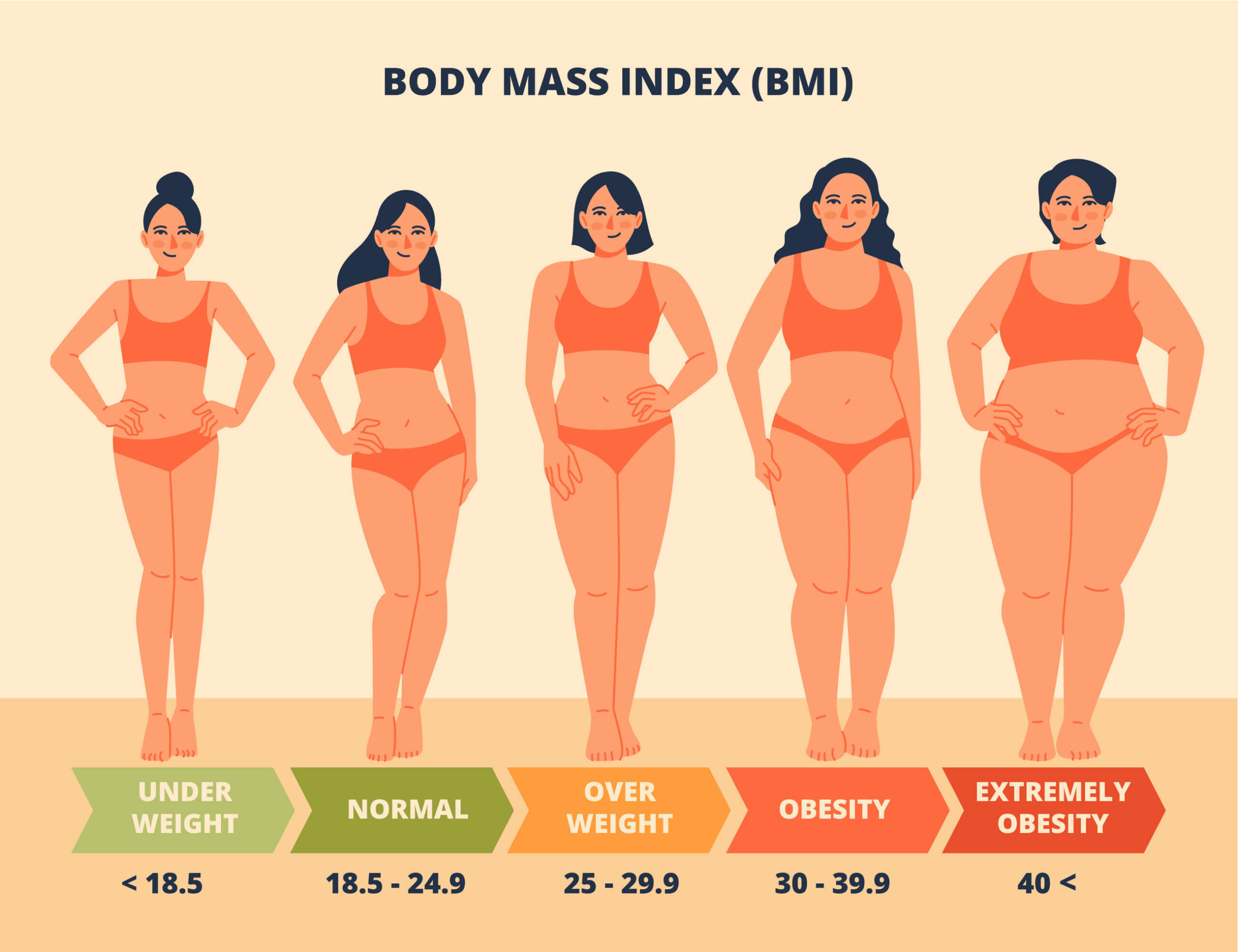
Ideal BMI Table
Here’s a table to help you understand better where your BMI stands and what it means:
| Height | Moderate weightBMI 19–24 | OverweightBMI 25–29 | ObesityBMI 30–39 | Severe obesityBMI 40+ |
| 4 ft 10 in(58 in) | 91–115 lb | 119–138 lb | 143–186 lb | 191–258 lb |
| 4 ft 11 in(59 in) | 94–119 lb | 124–143 lb | 148–193 lb | 198–267 lb |
| 5ft(60 in”) | 97–123 lb | 128–148 lb | 153–199 lb | 204–276 lb |
| 5 ft 1 in(61 in) | 100–127 lb | 132–153 lb | 158–206 lb | 211–285 lb |
| 5 ft 2 in(62 in) | 104–131 lb | 136–158 lb | 164–213 lb | 218–295 lb |
| 5 ft 3 in(63 in) | 107–135 lb | 141–163 lb | 169–220 lb | 225–304 lb |
| 5 ft 4 in(64 in) | 110–140 lb | 145–169 lb | 174–227 lb | 232–314 lb |
| 5 ft 5 in(65 in) | 114–144 lb | 150–174 lb | 180–234 lb | 240–324 lb |
| 5 ft 6 in(66 in) | 118–148 lb | 155–179 lb | 186–241 lb | 247–334 lb |
| 5 ft 7 in(67 in) | 121–153 lb | 159–185 lb | 191–249 lb | 255–344 lb |
| 5 ft 8 in(68 in) | 125–158 lb | 164–190 lb | 197–256 lb | 262–354 lb |
| 5 ft 9 in(69 in) | 128–162 lb | 169–196 lb | 203–263 lb | 270–365 lb |
| 5 ft 10 in(70 in) | 132–167 lb | 174–202 lb | 209–271 lb | 278–376 lb |
| 5 ft 11 in(71 in) | 136–172 lb | 179–208 lb | 215–279 lb | 286–386 lb |
| 6 ft(72 in) | 140–177 lb | 184–213 lb | 221–287 lb | 294–397 lb |
| 6 ft 1 in(73 in) | 144–182 lb | 189–219 lb | 227–295 lb | 302–408 lb |
| 6 ft 2 in(74 in) | 148–186 lb | 194–225 lb | 233–303 lb | 311–420 lb |
| 6 ft 3 in(75 in) | 152–192 lb | 200–232 lb | 240–311 lb | 319–431 lb |
| 6 ft 4 in(76 in) | 156–197 lb | 205–238 lb | 246–320 lb | 328–443 lb |
How to interpret your BMI
- Underweight (BMI < 19): It might indicate that you aren’t getting enough nutrients or could have a health issue. It’s important to consult a doctor to assess your situation.
- Normal Weight (BMI 19 – 24.9): Shows that you are at a healthy weight for your height. This is great, but remember to maintain a balanced diet and regular exercise.
- Overweight (BMI 25 – 29.9): Could indicate that you’re consuming more calories than needed. A change in diet and increased physical activity can help reach a healthier weight.
- Obesity (BMI > 30): It’s a warning that you’re at risk for various weight-related diseases like diabetes and heart diseases. It’s crucial to seek medical advice for a safe and healthy weight loss plan.
Conclusion
Maintaining a healthy Body Mass Index (BMI) isn’t just about numbers on a scale or tape measure. It’s about taking care of your body to feel good about yourself. A healthy BMI not only helps prevent diseases like diabetes and heart problems but can also boost your self-esteem. When you feel healthy inside, it shows on the outside.
It’s important to remember that BMI is a starting point. It can provide an overview of your health but shouldn’t be the only indicator. Combined with healthy eating habits, regular exercise, and medical care, you can achieve a balanced and sustainable lifestyle.
Always prioritize your well-being above all else. Don’t compare yourself to unrealistic standards; every body is unique and deserves to be treated with love and respect. Taking care of yourself isn’t just about physical health but also emotional health. Seek the balance that works for you and keep moving towards a healthier, happier life.
Ready When You Are
Ready to take the next step? Schedule a free consultation
You’ve got the numbers — the next step is a professional assessment that looks at more than a formula.